
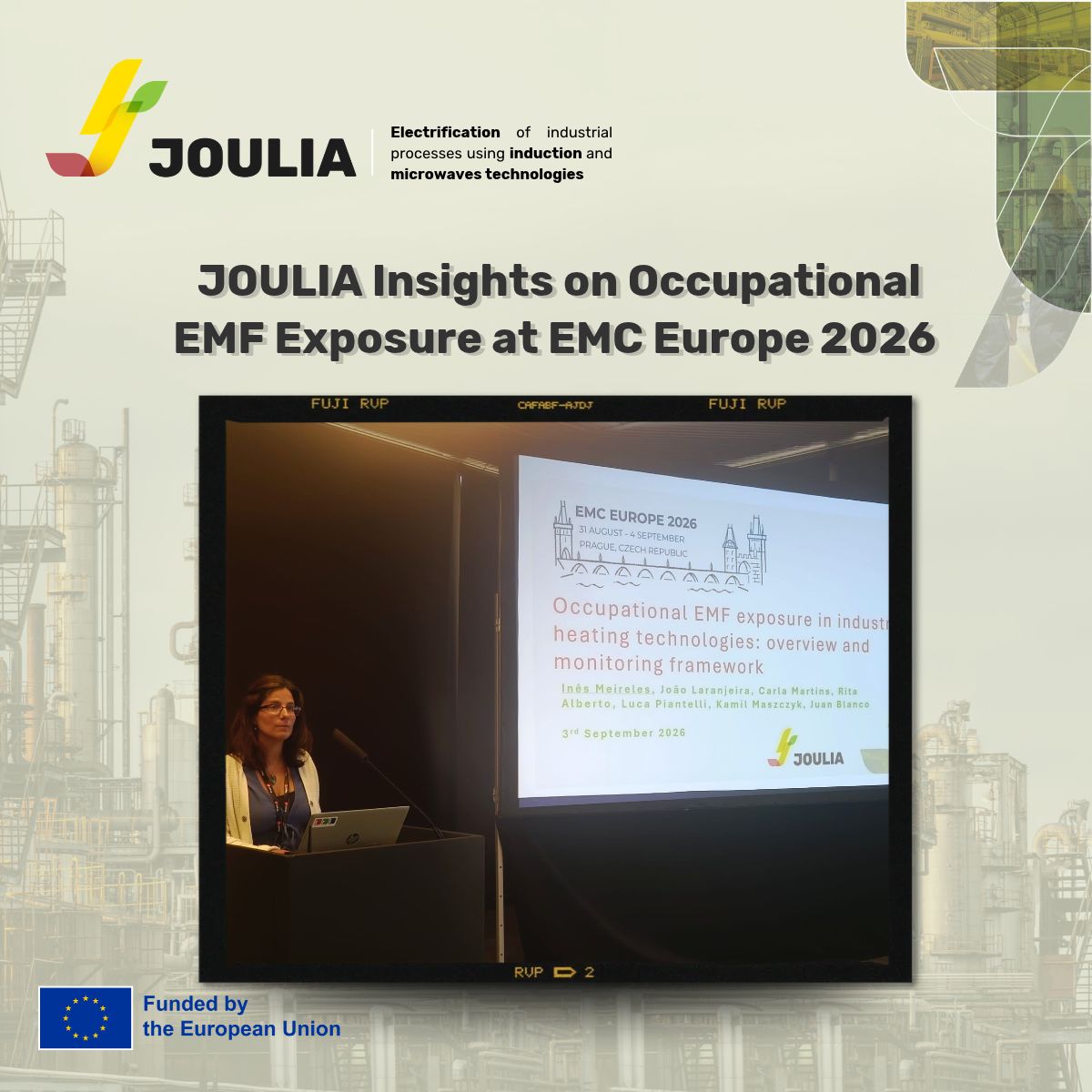
As European industry moves towards electrified heating, replacing fossil-fuel-based processes is only part of the challenge. New technologies must also be integrated into factories in a way that protects workers and responds to the realities of industrial operating environments. This challenge is being addressed directly within JOULIA, where health and safety are being considered alongside the development of induction and microwave heating technologies. On 3 September 2026, JOULIA partner ISQ brought this work to the international scientific community at EMC Europe 2026 in Prague, presenting the paper “Occupational EMF Exposure in Industrial Heating Technologies: Overview and Monitoring Framework.” The conference contribution translates research carried out within JOULIA into a practical framework for understanding and assessing occupational exposure to electromagnetic fields (EMFs) around industrial heating technologies.
Induction and microwave heating offer important advantages for industrial electrification, including precise and controllable heating and the potential for more efficient energy use. Both technologies, however, rely on electromagnetic fields to transfer energy to materials. Under normal operation, these fields are intended to remain controlled within coils, applicators or shielded systems. Nevertheless, factors such as equipment configuration, shielding integrity, maintenance conditions and the proximity of workers to the equipment can influence occupational exposure. For industry, this means that introducing electrified heating is not only a question of technology performance. It also requires understanding where workers are positioned, what tasks they perform and how the electromagnetic environment changes during operation. The research presented at EMC Europe therefore approaches safety through the conditions workers actually encounter in industrial settings.
The conference paper builds directly on the health-and-safety work carried out in JOULIA Task 4.3, led by ISQ. Within the project, this task supports the development of JOULIA technologies by identifying occupational hazards and risks early enough for preventive measures to be incorporated into the design and operation of the new systems. The work has been developed through two public project deliverables: D4.3 – Health and Safety Requirements – Preliminary Report and its M18 update, D4.5 – Health and Safety Requirements. These activities examine applicable regulations and standards, the specific characteristics of induction and microwave heating, potential occupational hazards and the measures needed to support safe design, installation, operation and maintenance. The paper presented in Prague takes this work a step further by describing a structured methodology for occupational EMF assessment organised around three stages: preparatory analysis and planning, field measurements, and interpretation of the resulting exposure data. Rather than assessing electromagnetic fields in isolation, the approach considers the wider operating context, including worker positions, specific tasks, equipment conditions and production stages.
An important feature of the work is that the methodology has already been applied as a baseline assessment in the two industrial environments relevant to JOULIA’s demonstration activities. Measurements were carried out under normal production conditions before the installation of the new JOULIA heating systems. The objective was to characterise the existing electromagnetic environment and establish a reference against which future conditions can be compared. The first environment relates to rubber flooring production, where JOULIA is developing an induction-based heating solution for the vulcanisation process. The second relates to multilayer polymer production, where the project is developing a microwave-based solution for adhesive activation. Measurements focused particularly on operator locations, task-specific positions and areas where workers may be closer to electromagnetic-field sources. The baseline results were reassuring: the maximum magnetic-field values reported in the study were approximately 0.004 mT at the first facility and 0.016 mT at the second, both far below the exposure limit referenced in the study. More importantly for the next stages of JOULIA, the measurements confirmed that the proposed monitoring methodology can be applied under real production conditions and helped identify the locations and activities that should receive particular attention during the full assessment campaign.
These findings have an important role within JOULIA’s wider development pathway. The project aims to demonstrate two fully electric heating processes based on induction and microwave technologies at TRL 7, while evaluating not only their technical and economic performance but also their environmental, health and safety implications. This means that occupational safety is being considered before the new systems reach full demonstration. The baseline established through the current work provides a reference point. Once JOULIA’s induction and microwave systems are installed and operating, further measurements can be used to compare conditions before and after electrification and to refine the health-and-safety requirements for their operation. The monitoring work therefore connects directly with JOULIA’s objective of producing health and safety recommendations that can support the safe integration and future replication of electrified heating technologies in industry.
Presenting the research at EMC Europe 2026 also takes the results beyond the project itself. The paper brought together authors from ISQ, ARTIGO, K-FLEX and CIRCE: Inês T. Meireles, João Laranjeira, Carla F. Martins, Rita S. Alberto, Luca Piantelli, Kamil Maszczyk and Juan Blanco. Sharing this work with specialists in electromagnetic compatibility and related fields creates an opportunity to connect the industrial electrification community with expertise in occupational exposure, measurement and electromagnetic safety. For technology providers and industrial operators considering the transition to electric heating, this exchange is particularly relevant. Scaling up electrification will depend not only on whether new systems can deliver the required temperatures, efficiencies and production rates, but also on whether they can be integrated confidently and safely into existing workplaces. The work presented at EMC Europe represents a baseline and methodological foundation, rather than the final assessment of JOULIA’s new technologies. The next phase will apply and refine the approach as the induction and microwave systems progress towards installation and demonstration. The resulting evidence will support more comprehensive exposure assessments and contribute to the health-and-safety requirements needed for their safe operation. By combining technology development with real-world occupational monitoring, JOULIA is helping ensure that the transition towards cleaner industrial heat is also a transition towards safe, responsible and deployment-ready electrification.
Conference contribution:
Occupational EMF Exposure in Industrial Heating Technologies: Overview and Monitoring Framework
Paper No. 178
EMC Europe 2026 – Prague, Czech Republic
September 2026
